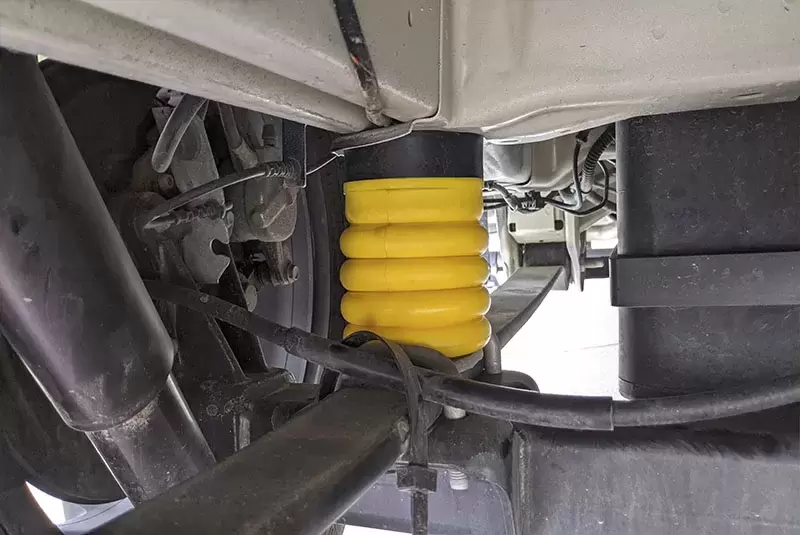

Vans and Class B RV platforms are no longer light-duty vehicles. Once converted or upfitted, they operate at weights and center-of-gravity profiles that are very different from how they left the factory. Whether it’s a fleet cargo van with shelving and equipment or a fully built-out camper with water tanks and lithium battery banks, added mass changes how the suspension behaves.
For builders, fleets, and RV manufacturers, the challenge isn’t simply adding capacity. It’s maintaining stability, ride height, and control without introducing unnecessary complexity.
Factory van suspensions are designed around mixed-use scenarios—some cargo, some empty driving, moderate loads, and comfort expectations. Once a van becomes a service vehicle or a Class B motorhome, it typically carries consistent, permanent weight.
Common additions include:
This added weight often concentrates toward the rear axle, increasing leverage and compressing the factory leaf springs more than intended.
The results are predictable:
In Class B RV platforms especially, high rooflines and elevated center of gravity amplify these effects.
The suspension is doing its job. It just wasn’t designed to do it at that weight, every mile.
When a van or Class B build carries consistent weight, mechanical suspension reinforcement often makes the most sense. Systems that engage automatically based on load eliminate the need for driver adjustment or ongoing maintenance.
SuperSprings International develops mechanical helper spring and load support systems designed to work alongside factory leaf packs. Rather than replacing the OEM suspension, these systems reinforce it.
For commercial vans and RV platforms, that approach offers several advantages:
For fleets, that reduces service complexity. For builders, it creates a repeatable, scalable upgrade across platforms.
Maintaining proper ride height is about more than aesthetics. When the rear of a van sags, the entire vehicle’s geometry shifts.
That can affect:
Over time, excessive rear sag increases wear on shocks and other suspension components because they operate outside their optimal range.
Mechanical helper springs engage progressively as weight increases. As load builds, support increases. That helps restore ride height and stabilize the rear axle without creating an overly harsh unloaded ride.
For RV manufacturers and van upfitters, this is particularly important when builds operate near GVWR consistently.
High-roof vans and Class B RVs present a large side profile. When combined with rear-heavy weight distribution, this increases susceptibility to sway from crosswinds or passing trucks.
Suspension reinforcement helps reduce excessive body roll by improving how load is distributed across the leaf pack. When the rear suspension remains more stable, steering input becomes more predictable.
For long-distance RV travel, that translates into less correction at the wheel and reduced driver fatigue. For fleet operators, it improves confidence and control in daily driving conditions.
Stability isn’t just about comfort. It’s about reducing stress on both the vehicle and the driver.
There are multiple approaches to improving van and Class B RV suspension performance. The correct solution depends on how the vehicle is used.
Mechanical helper springs are often ideal when:
Air-based systems can offer adjustability when loads vary significantly. However, they introduce additional components—compressors, airlines, fittings—that may require monitoring.
For commercial vans and RV builds where reliability is critical, fewer moving parts typically reduce long-term risk.
For RV manufacturers and van conversion companies, suspension consistency matters. Delivering a vehicle that maintains ride height and stability from day one enhances brand reputation and reduces post-delivery complaints.
Mechanical helper spring systems allow builders to standardize support packages across platforms such as:
By reinforcing the factory suspension rather than replacing it entirely, builders maintain OEM integration while improving load management.
For fleet managers operating multiple van platforms, standardization also simplifies maintenance planning.
Suspension upgrades for vans and Class B RV platforms should be evaluated through a durability lens. These vehicles accumulate significant mileage under consistent load.
Proper load support helps:
A mechanical solution that requires no driver intervention and no seasonal adjustment reduces long-term operational friction.
In commercial environments, predictability is often more valuable than adjustability.
Vans and Class B RV platforms have evolved into serious work vehicles and full-time travel rigs. They carry tools, equipment, and living systems that fundamentally change their weight profile.
Suspension solutions designed for these applications must account for consistent load, elevated center of gravity, and long-distance operation. Reinforcing the factory suspension mechanically provides a practical, durable approach to reducing sag, improving stability, and supporting long-term vehicle reliability.
When vans operate at capacity day after day, the suspension system should be built to match that demand.



 English English
  Spanish
  French
  German
  Italian English English Spanish
French
German
Italian
Italian English English Spanish
French
German
Italian

Tragen Sie sich in unsere E-Mail-Liste ein, um die neuesten Nachrichten, Tipps, Blogbeiträge und Angebote zu erhalten!